
,During a scientific seminar focused on the re-evaluation of the book Gharbzadegi (Occidentosis)
The Duality of Tradition and Modernity and the Critique of Western Intellectual Foundations
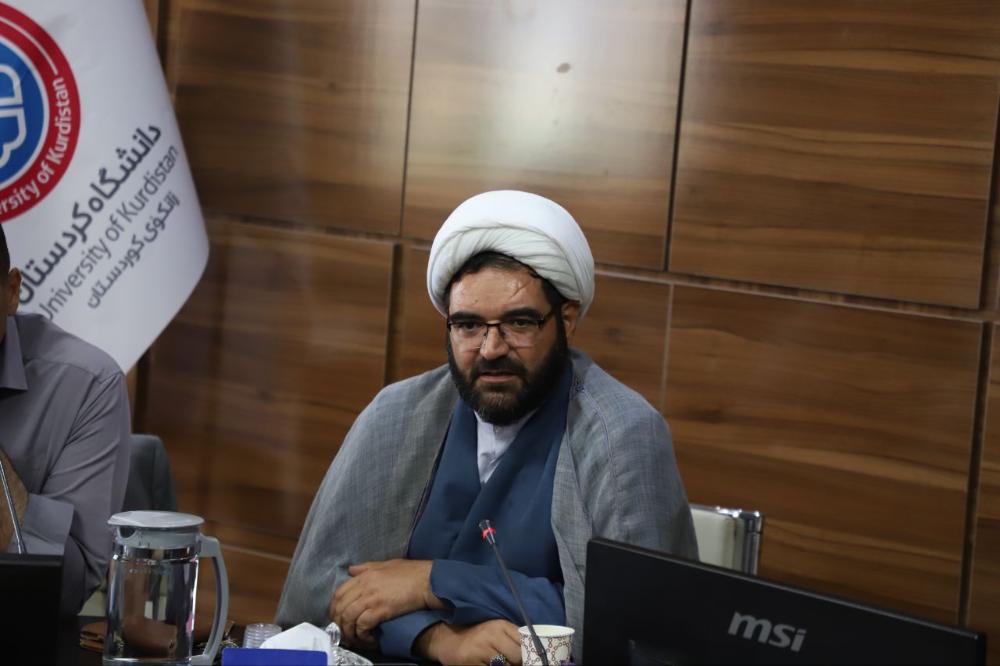



The Representative of the Supreme Leader at the University of Kurdistan discussed the confrontation between tradition and modernity and offered a critique of Western intellectual foundations.
Hojjat al-Islam wal-Muslimin Abedin Rostami, speaking at the seminar held on Sunday, May 31, 2026 (10 Khordad 1405) in the presence of faculty members, addressed the duality of tradition and modernity. He noted that the criteria for evaluation in any given era possess their own specific mechanisms and operate within that particular framework.
Emphasizing that modernity is not merely limited to a material lifestyle, he stated: "In comparative studies between nations, economic indicators alone cannot serve as a comprehensive measure of development or modernity; rather, a set of intellectual and theoretical foundations must also be considered."
Hojjat al-Islam Rostami identified several key components of Western modernity, asserting that Positivism (as extreme empiricism), Materialism, Secularism (the separation of religion from social spheres), and Liberalism (with its emphasis on individualism) constitute the pillars of this intellectual system.
According to the official, a central principle of modernity is Positivism, which posits that only data observable through the five senses is valid, thereby disregarding other domains of knowledge. He further enumerated Humanism, Rationalism—as opposed to revelation and intuition—and pluralism as additional elements of the modern intellectual framework. He emphasized that together, these components form the structure commonly referred to in public discourse as "West-orientedness."
Regarding the concept of pluralism, Hojjat al-Islam Rostami explained: "From this perspective, truth can be multifaceted and vary among individuals, whereas such a view is not accepted within traditional and religious thought."
In another part of his remarks, he touched upon Jalal Al-e-Ahmad’s critiques of the Constitutional Revolution, noting the discord between Western-oriented and Muslim constitutionalists. He also discussed the diminishing role of the clergy during certain historical periods following the revolution. He added that the concentration of major religious centers in Najaf, Karbala, and Samarra was a factor that contributed to the reduced direct involvement of the clergy in Iran's internal political developments; however, this role was revitalized following the Islamic Revolution.


Quick Links
Electronic Services
Useful Links


University of Kurdistan, Pasdaran Boulevard, Sanandaj, Iran

Postal Code: 6617715175

Phone: +988733664600-8

Email: info@uok.ac.ir


site visit
- today:
- yesterday:
- all:
Last Update
02 Jun 2026 - 07:54:47